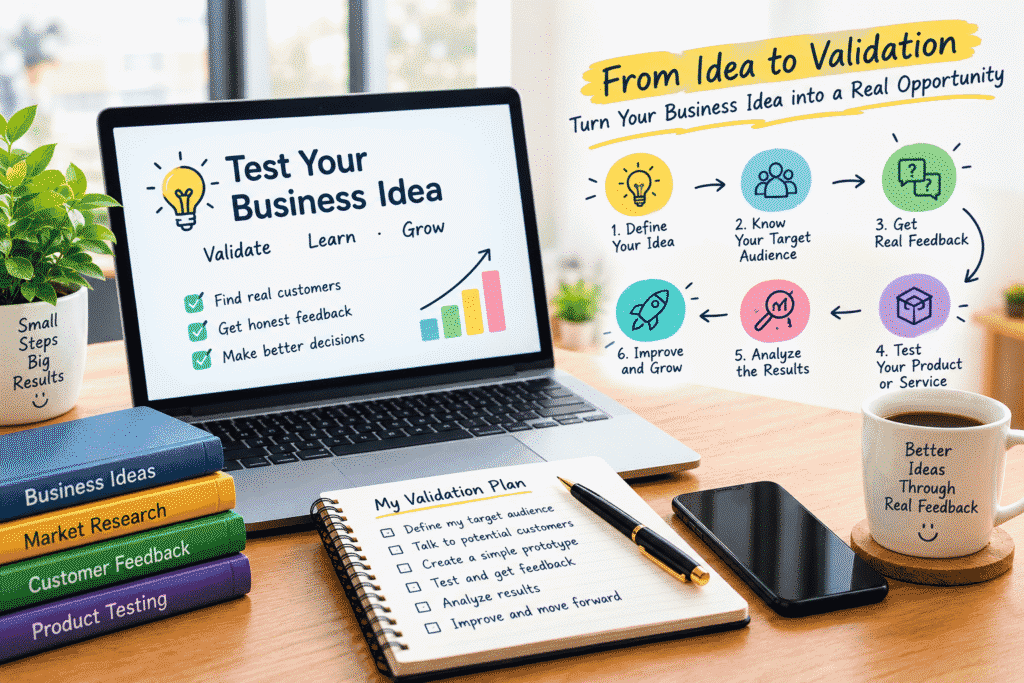
Test and Validate Your Business Idea or Product
Having a business idea can be exciting.
You might suddenly think, “People would definitely buy this!” You start imagining the brand, the website, the products, and maybe even your first big sales.
But there’s one important question you should answer before investing too much time and money:
Do people actually want it?
That’s what business validation is all about.
Instead of relying only on your own assumptions, you test your idea with real people, collect feedback, learn what they actually need, and use that information to improve your product or business.
The good news is that validation doesn’t always require a huge budget or a finished product.
You can start small.
What Does It Mean to Validate a Business Idea?
Business validation is the process of testing whether there is a real demand for your idea, product, or service.
Think of it as asking the market:
“Would you actually use this?”
And more importantly:
“Would you pay for it?”
A positive reaction from friends or family can feel encouraging, but it doesn’t necessarily prove that strangers will become customers.
Real validation comes from evidence.
That evidence might include:
Conversations with potential customers
Survey responses
Landing-page signups
Product pre-orders
Trial users
Customer interviews
Prototype testing
Actual purchases
You don’t need all of these. The right method depends on what you’re building.
Why You Should Test Before You Build
One of the most common mistakes new entrepreneurs make is building too much too early.
They spend months creating a product before discovering that customers wanted something slightly different.
Imagine spending six months developing an app, only to discover that your target users don’t consider its main feature important.
Testing early can help you discover that before the expensive part begins.
Validation isn’t about proving that your idea is perfect.
It’s about learning what needs to change before you invest heavily.
Step 1: Clearly Define Your Idea
Before testing anything, make sure you can explain your idea simply.
Answer questions like:
What are you offering?
Who is it for?
What problem does it solve?
Why would someone want it?
How is it different from existing alternatives?
If you can’t explain the idea clearly, potential customers may struggle to understand it too.
Try creating a simple one-sentence description:
“I help [target customer] solve [specific problem] with .”

This gives you a useful starting point for your research.
Step 2: Identify Your Target Customer
Not everyone is your customer.
The more specific you can be about who you’re trying to help, the easier it becomes to test your idea.
For example, instead of saying:
“My product is for business owners.”
You might say:
“My product is for small online retailers who struggle to manage customer orders.”
That’s much easier to research.
Think about:
Age and location
Job or lifestyle
Common problems
Buying habits
Budget
Current solutions
Frustrations with existing products
You don’t need to create a fictional customer profile just for the sake of it. Focus on real characteristics that help you identify potential customers.
Step 3: Talk to Potential Customers
This is one of the simplest and most valuable validation methods.
Talk to people who actually fit your target audience.
Don’t immediately start selling.
Instead, try to understand their problems.
Ask questions such as:
“How do you currently solve this problem?”
“What is the most frustrating part of the process?”
“How often does this problem happen?”
“What have you already tried?”
“What would make you switch to another solution?”
These questions can reveal things you never considered.
Sometimes you’ll discover that the problem is bigger than you expected.
Sometimes you’ll discover that people don’t care about it at all.
Both outcomes are useful.
Step 4: Study Existing Competitors
If other companies are already solving a similar problem, that’s not necessarily bad news.
In fact, competitors can provide useful information.
Study:
What they offer
Who they target
How they price their products
What customers like
What customers complain about
How they market themselves
What gaps exist in their offerings
Customer reviews can be particularly useful because they often reveal what people love and dislike about existing solutions.
Instead of simply asking, “How can I copy this business?”, ask:
“What can I learn from what customers are already saying?”
Step 5: Create a Simple Test
You don’t always need to build the complete product.
Create the smallest version that can help you test your main assumption.
This could be:
A basic prototype
A landing page
A sample product
A demo
A mockup
A free trial
A pre-order page
A simple service package
The purpose isn’t to create something perfect.
The purpose is to learn.
The Power of a Landing Page
A simple landing page can be surprisingly useful.
Explain:
What the product is.
Who it’s for.
What problem it solves.
Why someone might want it.
Then give visitors a meaningful next step, such as joining a waitlist, requesting information, booking a demo, or purchasing a clearly described offer.
The response can provide useful evidence about actual interest.
Step 6: Ask for Real Feedback
Don’t ask only:
“Do you like my idea?”
People often say yes because they want to be polite.
Instead, ask questions that reveal behavior.
For example:
Would you use this?
How do you solve this problem today?
What would stop you from buying it?
Which feature matters most?
What would you change?
How much would solving this problem be worth to you?
What would make you choose this over your current solution?
Most importantly, pay attention to what people do, not only what they say.
A person saying, “That’s a great idea!” is encouraging.
A person signing up, requesting a demo, joining a waitlist, or paying for the product provides stronger evidence of interest.
Step 7: Test Your Pricing
Pricing is another assumption worth testing.
You might think customers will happily pay $50, but customers may see the value differently.
Instead of guessing forever, explore different pricing approaches.
You can test:
Different price points
Monthly vs. annual plans
Basic vs. premium packages
One-time purchases
Introductory offers
Don’t choose a price simply because competitors charge it.
Think about the value your product provides, your costs, your audience, and the alternatives available to customers.
Step 8: Analyze What You Learn
After testing your idea, step back and look at the evidence.
Ask:
What did people consistently like?
What confused them?
What problems came up repeatedly?
What objections did they have?
Did people take meaningful action?
What should I change?
You may discover that your original idea needs a small adjustment.
That’s completely normal.
In fact, discovering that early can be one of the most valuable outcomes of validation.
Don’t Be Afraid to Change the Idea
Validation isn’t about protecting your original idea.
It’s about finding something people genuinely need.
Maybe you planned to sell Product A, but customer interviews show that people actually need Product B.
Maybe your target audience isn’t who you initially expected.
Maybe your pricing is wrong.
Maybe one feature matters much more than everything else.
Be willing to adapt.
Successful businesses often evolve significantly between the original idea and the final product.
Use AI to Support Your Validation Process
AI tools can also help you organize and explore your research.
For example, you can use AI to brainstorm customer interview questions, organize feedback, identify recurring themes, compare different customer segments, and generate ideas for experiments.
You could provide anonymized customer feedback and ask:
“Identify the five most common problems mentioned in these responses.”
Or:
“Group these customer comments into common themes.”
The important thing is to treat AI as an assistant for organizing and analyzing information — not as proof that your business idea will succeed.
Real customers and real-world behavior remain essential.
Common Validation Mistakes
Asking Only Friends and Family
Friends and family may genuinely want to encourage you.
Their opinions can be useful, but they shouldn’t be your only source of feedback.
Building Too Much Too Early
A full product isn’t always necessary for your first test.
Start with the smallest experiment that can answer your biggest question.
Ignoring Negative Feedback
Negative feedback can be uncomfortable.
But it may reveal the exact problem you need to solve.
Focusing Only on Compliments
Compliments feel good, but behavior tells you more.
Look for signups, purchases, trials, bookings, referrals, and other meaningful actions.
Trying to Prove Yourself Right
Your goal isn’t to prove that your idea is brilliant.
Your goal is to learn whether the market has a problem worth solving and whether your proposed solution is attractive enough to matter.
A Simple Business Validation Framework
You can remember the process like this:
IDEA → CUSTOMER → PROBLEM → TEST → FEEDBACK → IMPROVE → RETEST
Start with your idea.
Find the people who might need it.
Understand their problem.
Create a small test.
Collect honest feedback.
Improve your offer.
Then test again.
This process can save you from making large decisions based entirely on assumptions.
Final Thoughts
A great business idea is only the beginning.
The real challenge is discovering whether the market agrees with you.
Instead of spending months building something and hoping customers will appear, start asking questions early. Talk to potential customers. Study existing solutions. Create simple experiments. Look for real behavior. Learn from the results.
And remember: validation isn’t about getting a guaranteed yes.
Sometimes the most valuable answer is “not yet,” “not this way,” or “not for this customer.”
That information gives you a chance to make a better decision before you’ve invested too much.
Start small, stay curious, listen carefully, and let real-world feedback help shape your business idea into something people actually want.
