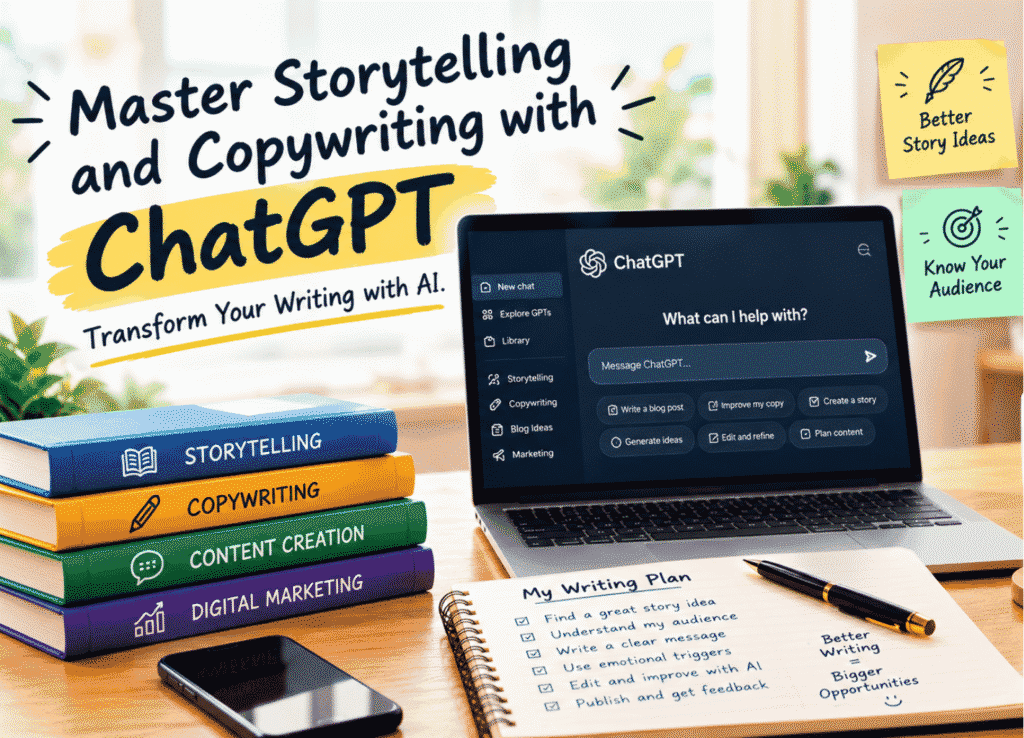
Master Storytelling and Copywriting with ChatGPT – Transform Your Writing with AI
Good writing has never been just about putting words together.
The words need to make people feel something. They need to create curiosity, explain an idea clearly, build trust, and sometimes even convince someone to take action.
That’s why storytelling and copywriting remain so important in today’s digital world.
But here’s the interesting part: you don’t have to do all of the creative work alone anymore.
With ChatGPT, writers, marketers, business owners, students, and content creators can use AI as a creative partner to develop ideas, improve drafts, understand audiences, and turn ordinary messages into more engaging content.
The goal isn’t to let AI write everything for you. It’s about learning how to use it intelligently while keeping your own voice and creativity at the center.
Why Storytelling Still Matters
People remember stories.
Think about the last advertisement, social media post, or brand message that genuinely stayed with you. Chances are, it wasn’t simply a list of features. It probably showed a problem, created an emotion, introduced a solution, or told a story that felt relatable.
Storytelling gives information meaning.
Instead of saying:
“Our product saves time.”
A story might show a busy business owner struggling to finish work late at night and then explain how the product helped simplify the daily routine.
The second approach gives the audience something they can imagine.
That’s the power of storytelling.
What Is Copywriting?
Copywriting is writing designed to communicate and persuade.
You’ll find copywriting everywhere:
-
Website headlines
-
Product descriptions
-
Landing pages
-
Advertisements
-
Emails
-
Social media captions
-
Sales pages
-
Video scripts
-
Call-to-action buttons
Good copy doesn’t simply tell people what something is. It helps them understand why it matters.
And this is where ChatGPT can become a useful writing assistant.
How ChatGPT Can Help With Storytelling
One of the hardest parts of writing is getting started.
You may have a good idea but not know how to turn it into a compelling story.
ChatGPT can help you explore different directions before you begin writing.
For example, you could give it a basic idea:
“I want to write a story about a small business owner who nearly gives up but discovers a better way to manage the business.”
From there, you can ask ChatGPT to brainstorm possible characters, conflicts, emotional turning points, settings, and endings.
You don’t have to use everything it suggests.
Think of these ideas as creative building blocks.
You choose what works.
Create Stronger Story Ideas
Sometimes the problem isn’t writing — it’s finding an interesting angle.
You can ask ChatGPT to generate different approaches to the same idea.
For example:
“Give me five different storytelling angles for introducing a new productivity app.”
One angle might focus on saving time.
Another might focus on reducing stress.
Another could tell the story through the experience of a small business owner.
The product hasn’t changed. The story has.
That gives you more creative possibilities.
Build Characters People Care About
Interesting characters aren’t simply names with descriptions.
They have goals, problems, fears, motivations, and conflicts.
ChatGPT can help you brainstorm these elements.
You might ask:
-
What does this character want?
-
What is stopping them?
-
What are they afraid of?
-
What mistake could they make?
-
How might they change by the end?
-
What personal experience could make them relatable?
You can then take the ideas that feel authentic and develop them in your own voice.
Use ChatGPT for Better Copywriting
Storytelling helps people connect with an idea.
Copywriting helps communicate that idea clearly and encourage action.
ChatGPT can be especially useful during the drafting and editing stages.
Write Better Headlines
A headline has one important job: make someone want to keep reading.
Instead of settling for your first idea, you can ask ChatGPT to generate multiple headline directions.
For example:
“Write 15 website headlines for a beginner-friendly digital marketing course. Keep them clear, natural, and benefit-focused.”
You can then compare the suggestions and rewrite the strongest ones.
The final headline doesn’t have to be AI-generated. You might simply use the ideas to discover a better version yourself.
Improve Product Descriptions
A weak product description might simply list specifications.
A stronger one explains how those features benefit the customer.
You can give ChatGPT your actual product information and ask it to rewrite the description for a specific audience.
For example:
“Rewrite this product description for busy professionals. Keep it friendly, concise, and focused on practical benefits.”
This gives you a starting point that you can personalize before publishing.
Write for a Specific Audience
One of the biggest mistakes in copywriting is trying to speak to everyone.
Different audiences care about different things.
A student might care about affordability and simplicity.
A business owner might care about efficiency and return on investment.
A parent might care about convenience and reliability.
ChatGPT can help you think through these differences.
You can ask it to analyze your audience and identify:
-
Their common problems
-
Their goals
-
Their concerns
-
Questions they may ask
-
Reasons they might hesitate
-
Language they are likely to respond to
Then use those insights to make your writing more relevant.
Give Your Writing a Human Voice
This is one of the most important parts of using AI for writing.
AI-generated text can sometimes sound too polished, repetitive, or generic.
That’s why you shouldn’t simply copy and paste everything ChatGPT produces.
Add your own experiences.
Use words you naturally use.
Include real examples.
Change sentences that don’t sound like you.
Add opinions where appropriate.
Tell stories from your own perspective.
The result should feel like your writing improved with AI assistance, not like a machine replaced your voice.
Turn One Idea Into Multiple Pieces of Content
Another useful way to work with ChatGPT is content repurposing.
Imagine you’ve written a detailed blog post.
That same idea could become:
-
A LinkedIn post
-
Several Facebook posts
-
Instagram captions
-
Short video scripts
-
Email content
-
A newsletter
-
FAQ questions
-
A carousel outline
-
YouTube video ideas
Instead of constantly searching for something new to say, you can explore different ways to present the same valuable idea.
This can make content creation much more manageable.
Use ChatGPT as Your Editing Partner
Writing the first draft is only half the process.
Good writing usually becomes better through editing.
You can ask ChatGPT to help identify:
-
Unclear sentences
-
Repeated ideas
-
Weak transitions
-
Unnecessary words
-
Grammar problems
-
Confusing explanations
-
Sections that need more detail
You can also ask for different tones.
For example:
“Make this sound more conversational without changing the meaning.”
Or:
“Make this professional but still friendly.”
Or:
“Simplify this paragraph so a beginner can understand it.”
These types of prompts can make the editing process much faster.
A Simple Storytelling + Copywriting Workflow
If you’re new to AI-assisted writing, don’t make the process complicated.
Try this workflow:
Step 1: Start With Your Idea
Write down what you want to communicate.
Don’t worry about making it perfect.
Step 2: Define Your Audience
Ask yourself who you’re writing for and what they actually care about.
Step 3: Brainstorm With ChatGPT
Use AI to explore angles, ideas, headlines, characters, examples, and possible structures.
Step 4: Write Your First Draft
Take the useful ideas and create your own draft.
Step 5: Improve the Draft
Ask ChatGPT to help identify weak sections, unclear sentences, and opportunities to improve the flow.
Step 6: Add Your Personality
This step matters.
Add your own experiences, opinions, examples, humor, and natural writing style.
Step 7: Final Review
Read the finished piece yourself.
If something doesn’t sound natural, change it.
Common Mistakes to Avoid
Using ChatGPT doesn’t automatically make writing better.
There are a few mistakes worth avoiding.
Don’t Accept the First Draft
The first AI response is often just a starting point.
Ask follow-up questions and refine it.
Don’t Make Every Sentence Sound Perfect
Human writing isn’t always perfectly polished.
Sometimes a simple, natural sentence is more engaging than an overly sophisticated one.
Don’t Invent Facts
If you’re writing about products, businesses, statistics, or real events, verify important information before publishing.
Don’t Lose Your Voice
AI should support your creativity, not erase it.
Your experiences and perspective are what make your content different from everyone else’s.
The Future of AI-Assisted Writing
AI is changing how people approach writing.
But that doesn’t mean human creativity is becoming less important.
In many ways, the opposite may be true.
When AI handles some of the repetitive work — brainstorming variations, organizing ideas, checking drafts, or creating starting points — writers can spend more time thinking about the things that really matter:
What should I say?
Why does it matter?
Who am I saying it to?
What do I want them to feel or understand?
Those are creative questions.
And they’re still deeply human.
Final Thoughts
Storytelling gives your ideas emotion.
Copywriting gives them direction.
ChatGPT can help you bring the two together by making it easier to brainstorm, draft, edit, experiment, and refine your writing.
But the strongest results come when you treat AI as a creative partner rather than a replacement for your own thinking.
Bring the ideas.
Bring the experience.
Bring the personality.
Let AI help you shape them into stronger words.
That’s how you can use ChatGPT not just to write more, but to write with greater clarity, creativity, and impact.
