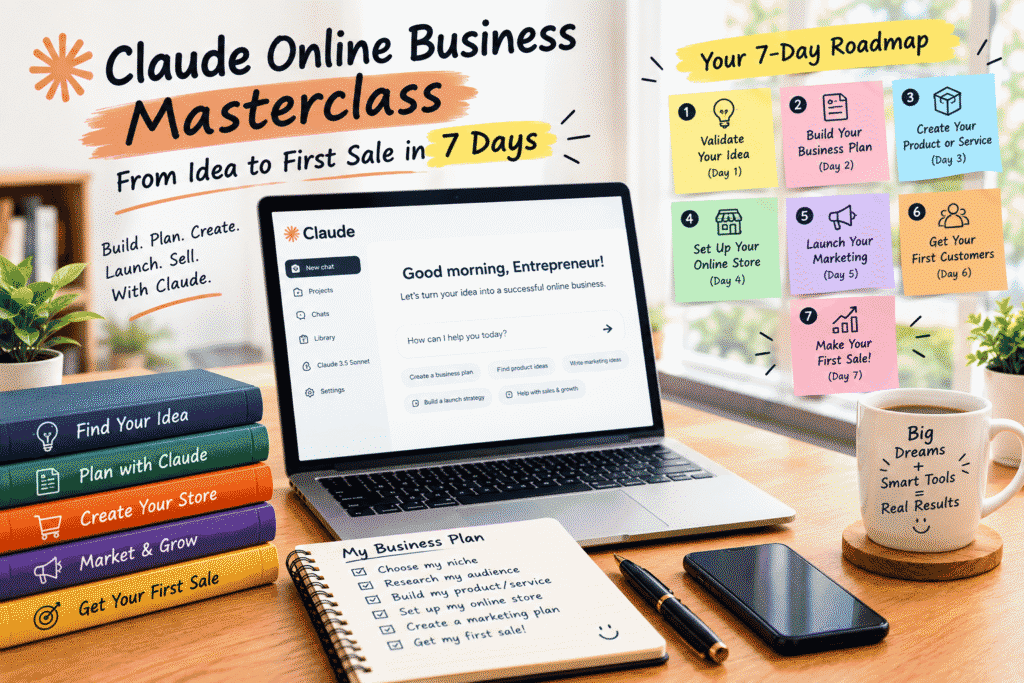
Claude Online Business Masterclass: From Idea to First Sale in 7 Days
Starting an online business sounds exciting until you actually sit down to do it.
You have an idea, but then the questions start coming.
What should I sell? Who will buy it? How do I create the offer? Where should I find customers? What should I post? How do I get that first sale?
For many beginners, the hardest part isn’t a lack of ideas. It’s turning an idea into something real.
That’s where AI can make the process much easier.
With Claude, you can use AI as a practical business assistant to brainstorm ideas, research your market, plan your offer, create content, organize your launch, and work through the many small tasks involved in getting an online business off the ground.
The goal isn’t to expect AI to build a successful business for you. The goal is to use it to move faster, think more clearly, and spend less time staring at a blank page.
Why Start an Online Business With AI?
Building a business traditionally involves a lot of research and repetitive work.
You may need to:
-
Research potential markets
-
Define your target customer
-
Develop a product or service
-
Write a business plan
-
Create a website
-
Write marketing copy
-
Plan social media content
-
Respond to customer questions
-
Analyze feedback
AI can help with many of these tasks.
Instead of spending hours trying to figure out how to structure a document or write your first marketing message, you can use Claude to create a starting point and then refine it based on your own knowledge.
That can be especially helpful when you’re working alone.
Day 1: Find and Validate Your Business Idea
The first day should be about clarity.
Don’t rush into creating a website or ordering inventory.
Start by asking:
What problem can I solve?
A good business idea usually connects three things:
A real problem + a specific audience + a useful solution.
Claude can help you brainstorm ideas based on your skills, interests, experience, and potential market opportunities.
For example, you could ask:
“I have experience in graphic design and social media. Give me 10 online business ideas that solve specific problems for small businesses. For each idea, explain the target customer and possible way to make money.”
This gives you several directions to explore.
But don’t stop there.
Talk to potential customers and research the market before assuming an idea will work.
AI can help you organize your thinking, but real-world demand has to be tested outside the AI conversation.
Day 2: Understand Your Customer
Once you’ve chosen an idea worth exploring, figure out who you’re actually selling to.
“Everyone” isn’t a useful target audience.
A specific customer is easier to understand and reach.
Think about:
-
Their biggest problems
-
What they want to achieve
-
What they currently use
-
What frustrates them
-
How they make purchasing decisions
-
What might stop them from buying
You can use Claude to organize this information into a customer profile.
More importantly, use it to generate questions you can ask real people.
Customer conversations can reveal things that AI-generated assumptions simply can’t.
Day 3: Create Your Product or Service
Now turn the idea into an actual offer.
Your first version doesn’t need to be enormous.
In fact, keeping it simple can be a smart approach.
If you’re selling a service, define exactly what the customer receives.
If you’re selling a digital product, determine what problem it solves and what the customer gets after purchasing.
If you’re selling physical products, consider your product selection, pricing, delivery, and customer experience.
Claude can help you structure:
-
Product ideas
-
Service packages
-
Features
-
Benefits
-
Pricing options
-
Product descriptions
-
Frequently asked questions
-
Customer onboarding materials
The important thing is to keep your offer focused.
Don’t try to solve ten different problems with your first product.
Day 4: Build Your Online Presence
Once your offer is clear, it’s time to give people somewhere to find you.
Depending on your business, this could be:
-
A website
-
An online store
-
A landing page
-
A social media profile
-
A marketplace listing
Claude can help you draft website sections such as:
Headline
About
Product or service description
Benefits
Frequently Asked Questions
Call to Action
You can also ask it to rewrite your copy for different audiences and tones.
But don’t let AI make your website sound generic.
Add real information about your business, your experience, your customers, and what makes your offer different.
Day 5: Create Your Marketing Plan
Now you need to start getting attention.
You don’t necessarily need a huge advertising budget.
Start by choosing one or two channels where your target customers are already active.
For example:
-
Instagram
-
Facebook
-
TikTok
-
YouTube
-
LinkedIn
-
Email
-
Search engines
-
Online communities
Claude can help you develop a simple content calendar.
You could ask:
“Create a 7-day social media content plan for my online business. Include a hook, post idea, caption direction, and call to action for each day.”
Then customize the ideas so they sound like your brand.
Your goal isn’t to post constantly.
Your goal is to consistently communicate something useful to the people who might become customers.
Day 6: Find Your First Customers
This is where many new entrepreneurs hesitate.
They wait for people to discover their business.
Don’t just wait.
Start conversations.
Reach out to people who genuinely fit your target audience. Participate in relevant communities. Share useful content. Contact potential customers personally when appropriate.
You can use Claude to help write:
-
Outreach messages
-
Introduction emails
-
Follow-up messages
-
Sales scripts
-
Social media posts
-
Customer FAQs
But personalization matters.
Nobody wants to receive a message that obviously looks like it was copied and sent to hundreds of people.
Make your communication relevant and respectful.
Day 7: Focus on the First Sale
The first sale can feel like a huge milestone.
It proves that someone was willing to exchange real money for what you’re offering.
But don’t become obsessed with making everything perfect before you launch.
Your first sale is also a learning opportunity.
Ask the customer:
Why did you choose this product?
What problem were you trying to solve?
What almost stopped you from buying?
What could we improve?
Those answers can help you improve your offer and marketing.
Your first customer isn’t just a buyer.
They can also teach you how to build a better business.
How Claude Can Support the Entire Process
One of the biggest advantages of using AI is that you don’t have to use it for only one task.
You can keep returning to it throughout the business-building process.
For example:
Idea: Brainstorm business opportunities.
Research: Organize market information.
Planning: Build a simple business roadmap.
Product: Develop your offer.
Branding: Explore names, messaging, and positioning.
Content: Create drafts and content ideas.
Marketing: Plan campaigns and social media.
Sales: Prepare outreach and follow-ups.
Improvement: Analyze feedback and identify changes.
This makes Claude less like a one-time writing tool and more like a flexible assistant that can support different stages of your workflow.
Don’t Expect AI to Build the Business for You
This is an important point.
AI can help you move faster, but it doesn’t remove the need for human judgment.
Claude can’t talk to your customers for you.
It can’t guarantee that your product will sell.
It can’t know your market better than real research and experience.
And it can’t replace your responsibility for important business decisions.
Use AI to generate possibilities and organize information.
Then test those ideas in the real world.
A Simple 7-Day Framework
You can think of the entire masterclass as a simple journey:
Day 1 — Idea: Find and validate a business opportunity.
Day 2 — Customer: Understand who you’re serving.
Day 3 — Offer: Create a useful product or service.
Day 4 — Presence: Build your basic online presence.
Day 5 — Marketing: Start attracting attention.
Day 6 — Customers: Begin conversations and outreach.
Day 7 — Sales: Focus on converting your first customer and learning from the experience.
The exact timeline will be different for every business. Some ideas will require more research, development, or testing.
The important thing is to keep moving from thinking to doing.
What Happens After the First Sale?
Getting your first sale is exciting, but it’s not the finish line.
It’s the beginning of the next stage.
Now you can start asking better questions.
Can I get another customer?
Can I improve the product?
Can I increase my conversion rate?
Can I make the process more efficient?
Can I turn customers into repeat buyers?
Can I build a stronger brand?
Can I scale what works?
The first sale gives you something incredibly valuable: real-world information.
Use it.
Final Thoughts
You don’t need to have everything figured out before starting an online business.
You need a useful idea, a specific customer, a clear offer, and the willingness to test your assumptions.
Claude can help make that process more organized and efficient. It can help you brainstorm, plan, write, research, and refine your ideas as you move from one stage to the next.
But the real work still happens outside the AI chat.
You have to talk to customers.
You have to test the offer.
You have to publish.
You have to ask for the sale.
And you have to learn from what happens.
So don’t wait until your business is perfect.
Start with the idea. Take the first step. Use AI to move faster. Learn from real customers. Then keep improving.
Your first sale may be only the beginning, but it can be the moment when an idea finally becomes a real business.
