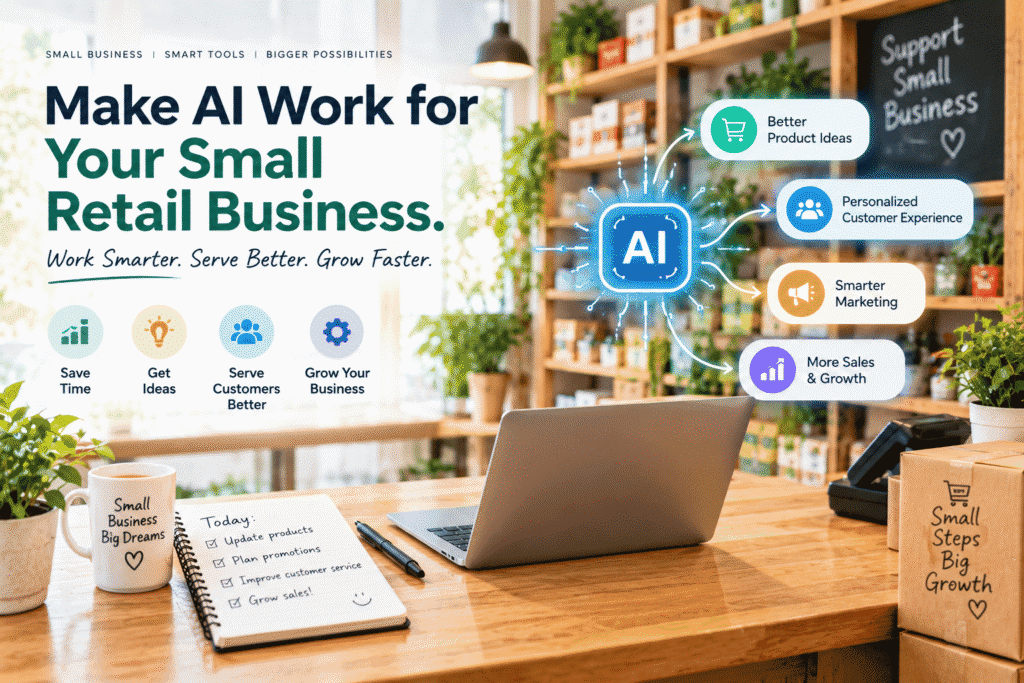
Make AI Work for Your Small Retail Business
Running a small retail business means wearing many hats. One day you’re checking inventory, the next you’re answering customer questions, creating social media posts, planning promotions, and trying to figure out what products people actually want.
It can be a lot.
The good news is that you don’t have to do everything manually anymore. Artificial intelligence (AI) is becoming a practical tool for small businesses, and you don’t need to be a technology expert to start using it.
The real question isn’t whether AI can help your business. It’s how you can use it in a way that actually saves you time and makes your daily work easier.
AI Isn’t Just for Big Companies
When people hear “AI,” they often imagine large corporations with expensive software and teams of engineers.
That’s changing.
Today, small retailers can use AI-powered tools for everyday tasks such as writing product descriptions, creating marketing ideas, analyzing information, answering common customer questions, and organizing business activities.
You don’t need to introduce ten different AI tools at once. In fact, starting small is often the better approach.
Find one repetitive task that takes too much of your time and see whether AI can help.
1. Create Marketing Content Faster
Marketing is important for almost every retail business, but creating fresh content consistently can be difficult when you’re busy running the store.
AI can help you brainstorm:
- Social media post ideas
- Product descriptions
- Promotional messages
- Email campaigns
- Blog topics
- Advertising headlines
- Seasonal campaign ideas
For example, instead of staring at a blank screen, you could ask an AI assistant:
“Write five Facebook post ideas promoting our new summer collection. Keep them friendly, short, and suitable for local customers.”
You can then review the suggestions, add your own information, and turn them into content that sounds like your business.
AI gives you a starting point—you provide the personality.
2. Understand Your Customers Better
Your customers are one of your most valuable sources of information.
What products do they ask about? What do they buy together? Which products sell quickly? What questions keep coming up?
AI can help you organize and analyze this type of information so you can spot patterns that might otherwise be easy to miss.
For example, if certain products are frequently purchased together, you might create a bundle or special offer around them.
The goal isn’t to let AI decide everything for you. Instead, use it to help turn everyday business information into useful insights.
3. Make Inventory Management Easier
Inventory can be one of the biggest headaches for a small retailer.
Too much stock ties up money and storage space. Too little stock can mean disappointed customers and missed sales.
Depending on the tools you use and the data available, AI can help identify sales patterns, highlight fast-moving products, and support demand planning.
Even a simple analysis of your previous sales can help you ask better questions:
Which products are selling consistently?
Which items are sitting on the shelf too long?
When do customers usually buy certain products?
These insights can help you make more informed purchasing decisions.
4. Improve Customer Service
Customers appreciate quick and helpful answers.
AI can assist with common questions about products, opening hours, delivery information, returns, availability, and other routine topics.
For example, an AI-powered chatbot or messaging assistant can handle simple questions while you focus on customers who need personal attention.
But there’s an important balance here.
Retail is still a human business. Customers often want to speak to a real person when they have a complicated problem or need personalized advice.
Use AI to handle the repetitive questions—not to remove the human side of your business.
5. Write Better Product Descriptions
A good product description can help customers understand why a product is worth buying.
But writing descriptions for dozens or hundreds of products can take a huge amount of time.
AI can help create first drafts based on information such as:
- Product name
- Features
- Size
- Material
- Main benefits
- Target customer
- Usage instructions
You can then edit the description to make sure every detail is accurate.
This is especially useful for retailers who sell through an online store as well as a physical shop.
6. Get Ideas When You’re Stuck
Sometimes the hardest part of running a business is simply figuring out what to do next.
Should you run a weekend promotion?
What kind of content should you post?
How can you introduce a new product?
What could make your customer experience better?
AI can act as a brainstorming partner.
You can describe your situation and ask for different ideas. Some suggestions may not be useful, but others might spark an idea you hadn’t considered.
That’s one of the most practical ways to think about AI: not as an answer machine, but as a tool for exploring possibilities.
7. Make Smarter Business Decisions
Small retailers already have valuable data—even if they don’t think of it as “data.”
Sales records, customer feedback, product performance, website visits, and social media activity can all provide useful information.
AI tools can help summarize and analyze this information, making it easier to see what’s working and where you may need to make changes.
Instead of relying entirely on guesswork, you can combine your own experience with information from your business.
That combination can be powerful.
You Don’t Need to Become an AI Expert
This is probably the most important thing to remember.
You don’t need to understand how artificial intelligence works behind the scenes to benefit from it.
You simply need to learn how to give AI clear instructions and understand when its output needs to be checked.
Start with something simple.
For example:
Week 1: Use AI to create marketing ideas.
Week 2: Try it for product descriptions.
Week 3: Explore customer-service applications.
Week 4: Look at how AI can help analyze your business information.
Learning gradually makes the process much less overwhelming.
A Few Things to Keep in Mind
AI can be incredibly useful, but it isn’t perfect.
Always check important information before publishing or acting on it. AI can make mistakes, misunderstand context, or produce information that sounds convincing but isn’t correct.
You should also be careful with sensitive customer and business information. Don’t put private data into an AI service unless you understand how that service handles the information.
And most importantly, don’t use AI simply because it’s trendy.
Use it when it solves a real problem.
Start Small, Then Grow
You don’t need a massive AI strategy to get started.
Choose one task that takes up too much of your time. Try an AI tool. See whether it actually helps.
If it saves you an hour every week, that’s already valuable.
If it helps you create better marketing, respond to customers faster, or understand your sales more clearly, even better.
Over time, those small improvements can add up.
Final Thoughts
AI isn’t going to replace the personal relationships, local knowledge, and human judgment that make small retail businesses special.
Instead, it can take care of some of the repetitive work happening behind the scenes.
That means you can spend more time doing what matters: serving customers, improving your products, building your brand, and growing your business.
You don’t need to transform your entire business overnight.
Start with one task.
Find one problem.
Try one AI tool.
Learn what works.
Then build from there.
The goal isn’t to work more with AI. The goal is to make AI work for you.
