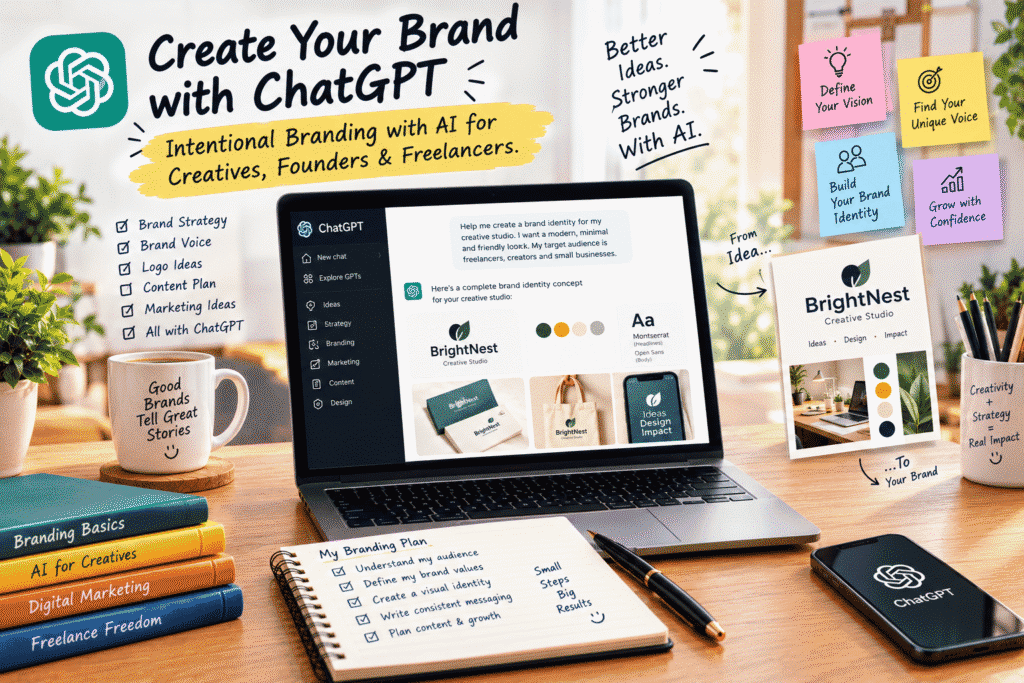
Create Your Brand with ChatGPT: Intentional Branding with AI for Creatives, Founders & Freelancers
Building a brand sounds exciting until you actually have to do it.
What should your brand say?
How should it sound?
What makes it different?
What colors should you use?
Who exactly are you trying to reach?
For creatives, founders, and freelancers, these questions can become overwhelming quickly. You might have a great business idea but struggle to turn that idea into a clear and consistent brand.
This is where AI can become surprisingly useful.
With ChatGPT, you can brainstorm ideas, clarify your positioning, develop your brand voice, explore messaging, plan content, and organize your thoughts before you start designing anything.
But there’s an important distinction: good branding isn’t about asking AI to invent your identity for you. It’s about using AI to help you uncover, organize, and communicate the identity you already want to build.
That’s what intentional branding is all about.
What Does Intentional Branding Mean?
Intentional branding means making deliberate choices about how people experience your business.
Instead of choosing a logo simply because it looks nice, you think about what the logo should communicate.
Instead of posting random content, you decide what your brand should be known for.
Instead of trying to appeal to everyone, you identify the people you actually want to attract.
A strong brand usually has clarity around:
Who you serve
What you offer
Why you’re different
What you believe
How you communicate
How you want people to feel
What makes your business memorable
ChatGPT can help you work through these questions, but you remain the person making the important decisions.
Start With Your Brand Story
Before thinking about colors, fonts, or logos, start with the story behind your brand.
Ask yourself:
Why did I start this?
Maybe you’re a freelancer who wants more independence. Maybe you’re building a company around a problem you’ve experienced yourself. Or perhaps you’re a creative who wants to turn a personal skill into a real business.
Write down your thoughts—even if they’re messy.
Then you can use ChatGPT to organize them.
For example, you could ask:
“Here is the story behind my business. Help me identify the main ideas, values, and themes that could become the foundation of my brand.”
The goal isn’t to let AI rewrite your personality.
The goal is to see your own ideas from a clearer perspective.
Define Your Ideal Audience
A brand becomes much easier to build when you know who you’re talking to.
“Everyone” isn’t really an audience.
Think about the specific people who would benefit most from your work.
Consider:
Their goals
Their problems
Their interests
Their frustrations
Their buying decisions
Their expectations
The language they naturally use
ChatGPT can help you turn a general audience description into a more useful customer profile.
For example, instead of:
“My audience is small businesses.”
You might discover something more specific:
“I help early-stage creative businesses that have good products but struggle to communicate their value online.”
That second statement gives you much more direction for your branding and content.
Find Your Brand Positioning
Positioning is one of the most important parts of branding—and one of the easiest to overlook.
Your positioning answers a simple question:
Why should someone choose you instead of another option?
You don’t necessarily need to be completely different from everyone else.
Sometimes your difference comes from your approach, experience, personality, specialization, audience, or the way you solve a particular problem.
Try asking ChatGPT questions such as:
“Help me identify possible positioning angles for my business.”
“What makes this business different based on the information I’ve provided?”
“What problems am I solving for my target customer?”
“Turn these business strengths into clear positioning statements.”
Don’t simply copy the first answer.
Look for ideas that actually sound like you.
Build a Brand Voice
Imagine two businesses selling exactly the same service.
One sounds formal, corporate, and serious.
The other sounds friendly, conversational, and energetic.
Even if their services are identical, they can create completely different impressions.
That’s the power of brand voice.
Your brand voice might be:
Friendly
Professional
Bold
Playful
Educational
Calm
Confident
Conversational
Inspirational
You can ask ChatGPT to help you explore different directions.
For example:
“Based on my audience and brand values, suggest three possible brand voice directions and explain how each would sound in social media posts.”
Then choose the direction that feels authentic.
The key is consistency.
Once you’ve defined your voice, use it across your website, emails, social media, advertisements, and other customer communications.
Create Your Brand Messaging
Once your positioning and voice are clear, you can start creating your core messaging.
Think about the sentences people should remember about your business.
You might need:
A One-Line Brand Statement
A short explanation of what you do and who you help.
A Tagline
A memorable phrase that captures the spirit of your brand.
An Elevator Pitch
A slightly longer explanation you can use when introducing your business.
Key Brand Messages
The important ideas you want to communicate repeatedly.
ChatGPT can help you generate and refine these options.
But don’t choose the cleverest sentence simply because it sounds impressive.
Choose the one that communicates your value clearly.
Clarity usually beats cleverness.
Use ChatGPT for Brand Name Ideas
If you’re starting from scratch, naming your business can feel impossible.
You can use ChatGPT as a brainstorming partner.
Give it useful context:
Industry
Target audience
Brand personality
Products or services
Desired feeling
Words you like
Words you don’t want
Whether the name should feel modern, premium, playful, traditional, etc.
Instead of asking:
“Give me 50 business names.”
Try:
“I’m building a modern creative studio for small businesses. I want the name to feel confident, simple, memorable, and approachable. Generate several naming directions and explain the thinking behind each.”
This produces a much more useful brainstorming session.
Of course, before adopting a name, you should check availability, trademarks, domains, and social handles yourself.
Turn Your Brand Into a Visual Direction
ChatGPT can also help you think through the visual side of your brand.
You can explore:
Color palettes
Typography directions
Photography styles
Illustration styles
Logo concepts
Layout preferences
Mood-board themes
Visual keywords
For example:
“My brand is a premium but approachable consulting business for creative entrepreneurs. Suggest three visual directions, including colors, typography style, imagery, and overall mood.”
This gives you a creative starting point before opening your design software.
Remember, AI-generated suggestions aren’t your final brand identity.
They’re possibilities.
Your job is to select, refine, and turn those possibilities into something cohesive.
Build a Content Strategy With AI
Once your brand identity starts taking shape, the next challenge is staying visible.
What should you post?
What should you talk about?
How often should you publish?
This is another area where ChatGPT can save a lot of time.
You can ask it to help organize content around categories such as:
Educational Content
Teach your audience something useful.
Problem-Solving Content
Address common frustrations or challenges.
Behind-the-Scenes Content
Show how you work and what happens behind your business.
Storytelling Content
Share experiences, lessons, failures, and successes.
Promotional Content
Explain your services, products, offers, or launches.
Opinion-Based Content
Share thoughtful perspectives related to your industry.
The important thing is to make the ideas your own.
Your experiences are what make your content different from thousands of other AI-generated posts.
Don’t Let AI Make Your Brand Sound Like Everyone Else
This is probably the biggest danger of using AI for branding.
If you ask AI to write everything for you, your brand can quickly start sounding generic.
You may notice phrases that feel polished but don’t actually sound like a real person.
That’s why your personal perspective matters.
Give ChatGPT your:
Real experiences
Opinions
Stories
Examples
Customer questions
Industry knowledge
Writing preferences
Then use AI to help organize and improve those raw materials.
Your experience is the ingredient AI cannot replace.
A Simple ChatGPT Branding Workflow
You don’t need to complete your entire brand in one afternoon.
Try working through the process step by step.
Step 1: Define Your Purpose
Why does your business exist?
Step 2: Identify Your Audience
Who are you trying to help?
Step 3: Clarify Your Value
What problem do you solve?
Step 4: Explore Your Positioning
What makes your approach different?
Step 5: Define Your Personality
How should your brand feel?
Step 6: Create Your Voice
How should your brand sound?
Step 7: Develop Your Messaging
Create your tagline, brand statement, elevator pitch, and key messages.
Step 8: Explore Visual Direction
Choose colors, typography, imagery, and design references.
Step 9: Build Your Content Framework
Decide what topics your brand should consistently talk about.
Step 10: Review Everything
Make sure your visual identity, messaging, voice, and content all feel like they belong to the same brand.
This process is much more useful than simply asking AI to “create a brand.”
What Creatives, Founders, and Freelancers Can Gain
Different people can use AI branding workflows in different ways.
For Creatives
AI can help turn creative ideas into a clearer personal brand and make it easier to communicate what you do.
For Founders
It can help organize your positioning, messaging, customer research questions, and content ideas while you’re building the business.
For Freelancers
It can help you move beyond simply saying what service you provide and start communicating the specific value you bring to clients.
In all three cases, the objective is the same:
Build a brand that people can understand, recognize, and remember.
Common Branding Mistakes to Avoid
Even with AI, some branding mistakes are still surprisingly common.
Trying to Appeal to Everyone
A brand becomes stronger when it knows who it is for.
Changing Your Message Every Week
Consistency helps people understand what you stand for.
Focusing Only on the Logo
A logo is one part of a brand—not the entire brand.
Copying Competitors
Study competitors to understand the market, but don’t build your identity around copying them.
Letting AI Make Every Decision
AI can provide options, but your values and judgment should guide the final choices.
Creating Without a Strategy
Beautiful visuals won’t fix unclear positioning.
Start with the message, then build the visual identity around it.
Your Brand Should Still Feel Like You
The most exciting thing about AI branding isn’t that it can create things quickly.
It’s that it can make the process of thinking easier.
You can explore ten ideas instead of one. You can test different messaging directions. You can turn rough thoughts into organized frameworks. You can ask questions when you’re stuck and keep moving instead of staring at a blank page.
But don’t forget why you’re building the brand in the first place.
People don’t connect with businesses simply because they have beautiful colors or clever taglines.
They connect with ideas, stories, personalities, experiences, and people.
Use AI to make those things clearer—not to hide them.
Final Thoughts
Creating a memorable brand doesn’t require you to have everything figured out from day one.
Start with your story.
Understand your audience.
Clarify what you offer.
Define what makes your approach different.
Then use ChatGPT as a creative thinking partner to explore ideas, organize your strategy, refine your messaging, and build a consistent content direction.
The strongest AI-assisted brands won’t necessarily be the ones using the most AI.
They’ll be the ones using AI intentionally.
So don’t ask ChatGPT to build a brand for you.
Ask it to help you build your brand, your way.
